
The institution holding an asset is not necessarily the firm earning the fee, controlling the customer interface or shaping the speed of a withdrawal. Banking scenarios need to separate those roles.
What the paper examines
BIS Working Paper No 1391 by Christian Schmieder, Renzo Corrias and Oliver Wünsch was published on 4 November 2026. The researchers classify approximately 9,000 banks across more than 150 jurisdictions and examine four possible paths combining technology, regulation, customer behaviour and macro-financial conditions. Their framework organises expert judgement; it is not a probabilistic forecast.
Asset market share can hide a revenue shift
Traditional banks retain roughly three-quarters of banking assets across the paper's scenarios, while new technology-driven models may capture a much larger share of fee-earning activity. Origination, payments, distribution and advice can move toward platforms while lending and funding risks remain on bank balance sheets. Asset ownership alone can therefore miss changes in the economics and incentives of intermediation.
The path from faster deposits to risk
Digital interfaces can shorten deposit-withdrawal response times. Increased reliance on external platforms may amplify operational dependencies, while changing revenue mixes can expose profitability to different cycles. A careful bank-risk model distinguishes deposit-runoff speed, funding concentration, fee-income durability, third-party disruption and how persistent earnings weakness could affect solvency.
How to use scenarios responsibly
Use several explicit assumptions rather than optimising around one projection. Scenario ranges are conditional outcomes, not calibrated probabilities or predictions for any individual bank. Teams should document the transmission mechanism from business-model change to liquidity and capital pressure, and stress the assumptions that matter most.
Primary source and limitations
This original ASR commentary separates source facts from risk-model interpretation. Primary source: BIS Working Paper No 1391, Schmieder, Corrias and Wünsch, 4 November 2026. Examples describe possible scenarios, not observed institution-level measurements.
ASR / MODEL & METHODOLOGY · EXHIBIT 04
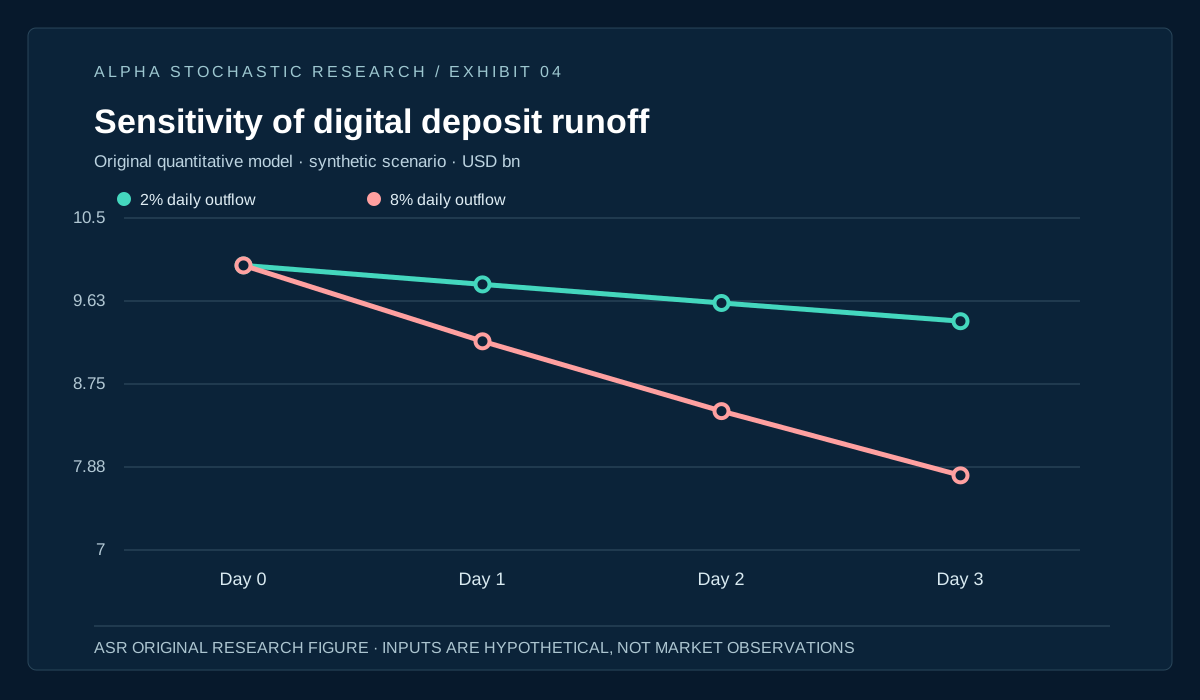
Sensitivity of digital deposit runoff
Original numerical illustration, not market-observed data. Inputs are explicit and calculated outputs can be independently reproduced.
Mathematical specification
Deposits_d = Deposits_0 * (1 - daily_outflow_rate)^dParameters and assumptions
| Input | Assumed value |
|---|---|
| Initial deposit balance | 10bn |
| Slow daily outflow | 2% of remaining deposits |
| Fast daily outflow | 8% of remaining deposits |
| Horizon | 3 days; no inflows |
Calculated scenario outcome
After three days the 2% scenario retains USD 9.412bn; the faster 8% scenario retains USD 7.787bn. The difference is USD 1.625bn of additional replacement funding.
Model limitations
The 2%/8% daily rates are ASR hypothetical sensitivities, NOT estimates from BIS Working Paper 1391. No depositor-level heterogeneity, correlation, new funding or calibrated bank-run probability is modelled.